
How to Choose an Online Poker Room to Play From the US
Choosing a US Poker Room: Everything You Need to Check Before Registering
The essentials:
- Online poker legality in the United States varies by state: only a small group has regulated and active rooms (Nevada, New Jersey, Delaware, Pennsylvania, Michigan, and West Virginia are most commonly cited as active).
- Outside those states, many players use international operators that accept registrations from the US without state-by-state regulation.
- Real US poker payment methods depend on room type: ACH, card, and physical cashiers at regulated sites; crypto and some cards at international operators.
- Identity verification (KYC) is nearly universal; what changes is the level of scrutiny, not whether it exists.
- Before depositing seriously, check traffic during your hours, support quality, and payment reputation.
Picking the right US poker room isn't just about rakeback or an attractive welcome bonus—it depends on whether that room can legally operate where you live, what payment methods you can actually use, and whether support responds when you have a withdrawal issue. Playing online poker in the US requires first understanding a fragmented regulatory map: what's legal in one state may not be in another, and understanding state-by-state poker legality is the foundation of any decision before you register. This guide covers what a US-based player should verify before signing up at any online room.
Availability by state and location
Your physical location—not your nationality or billing address—is what first determines whether a room works for you. In the United States, the online poker regulatory framework is decided state by state: a room perfectly valid for someone in Nevada may not operate the same way for someone in Texas or Florida.
State-licensed rooms use geolocation systems that verify you're physically inside the state where they're licensed, typically combining Wi-Fi data, GPS, and your connection details. If you travel outside that state, the room will commonly block real-money play access until you're back within the permitted area.
International operators accepting US players without state-by-state regulation typically don't apply that same internal geographic control, but that doesn't mean they're available or appropriate in all circumstances. Real availability depends on each operator's policies and can change.
Warning: Using a VPN to simulate being in another state or country is something regulated rooms explicitly prohibit, and it can result in account closure and fund forfeiture. It's not a safe shortcut.
State regulation versus international operators: poker legality by state
Two very different ecosystems exist in US online poker, and it's important not to mix them:
- •State-licensed rooms. Operate under a specific state's gaming commission where real-money online poker is active. They typically offer enhanced identity verification, formal consumer protection, and traditional banking payment methods.
- •International operators accepting US players. Not licensed by any US state. They accept registrations from US territory according to their own policies, and the legal player protection level differs from a locally regulated room.
There's no single "legal" or "illegal" answer that applies uniformly across the country: poker legality by state depends on where you play and what operator type you register with. This article doesn't replace legal advice; if you have specific concerns about your situation, it's worth reviewing your state's current regulations or consulting a professional.
Key fact: According to sources reviewed, no single federal law prohibits online play; the UIGEA focuses on payment processors rather than the act of playing directly, but in practice it heavily conditions how sites operate.
US poker payment methods: what's actually available
The payment method advertised on a room's homepage doesn't always match what you can actually use from your bank. When investigating available US poker payment methods in practice, the gap between advertised and operational options usually hides in the fine print. Here's what typically comes available by operator type:
Regulated rooms versus international operators: comparison table
| Room type | Typical deposit methods | Typical withdrawal methods |
|---|---|---|
| State-regulated | ACH/wire transfer, debit card, cash at affiliated physical location, cage at linked casino | ACH, physical check, casino cage, card when issuer allows |
| International operator (offshore) | Cryptocurrencies (BTC, USDT, similar), select cards | Crypto primarily, other methods per operator |
Indicative data per third-party sources consulted; always confirm current methods directly on each room's website before depositing.
Why crypto dominates at international operators
At international operators, crypto has become the most reliable method because it avoids friction with banks that block gaming-related charges, even when legal in the player's state. Networks known for accepting US traffic, such as those shared by BetOnline, Sports Betting, or Tiger Gaming, typically rely heavily on crypto deposits and withdrawals.
Tip: Always do a first test with a small deposit and matching withdrawal before moving your main bankroll. It lets you verify real timing and process without excessive risk.
Processing times: what to actually expect
Processing times aren't fixed—they vary by payment method, network used (in the case of crypto), and operator workload. Distrust any room promising "guaranteed instant withdrawals" as standard practice.
Poker identity verification: how KYC works
Virtually no serious room operates today without an identity verification process (KYC). It exists to meet anti-fraud and anti-money laundering rules, and to confirm the person withdrawing is the one who opened the account. Understanding how poker identity verification works before seriously depositing saves surprises at withdrawal time.
At state-licensed rooms, the process is usually more rigorous and includes official documents (driver's license, passport, or state ID), complete personal details, and sometimes proof of address. At international operators, the initial registration process may be lighter, but nearly all request verification before processing larger withdrawals.
Warning: If a room asks for no verification before a significant withdrawal, that's not necessarily an advantage. It can signal the process will apply later less predictably, or that the operator has weak internal controls.
It's reasonable to expect requests for identification and, at some point, proof of address or proof of ownership of the payment method used. The sooner you complete that process, the less friction you'll face when you actually want to withdraw.
Table selection and traffic hours
A room can have a solid reputation and still not fit you if traffic concentrates in a time zone that doesn't match your play hours. For a US-based player, what matters is activity in evening hours across EST or PST zones, which is typically when the most active tables are running at rooms catering to US traffic.
Before committing your bankroll, check the lobby during your regular hours:
- •How many cash tables are open at your specific NLH or PLO stakes.
- •Whether tournament guarantees run during hours you can actually play.
- •Whether your preferred format (heads-up, 6-max, quick tournaments) has consistent or occasional volume.
Pro tip: Open the client in play-money mode or low-limit stakes before depositing heavily. It lets you see whether the lobby traffic in your time window is real or just marketing window dressing.
Support quality
Support shows up when something breaks, not when everything works. Live chat responding in reasonable minutes, or email consistently resolving identity verification and withdrawal questions within a set timeframe, is far more useful than any welcome promotion.
Points to check before registering:
- •Whether live chat exists or it's ticket-only via email.
- •Whether support content is available in your preferred language.
- •Whether recent forums or reviews mention reasonable response times for withdrawal problems, not just general inquiries.
Operational reputation
Since much of the offer accessible from the US comes from international operators without state licensing, accumulated reputation carries more weight than in a fully regulated market. The most useful indicators are operator tenure, consistency in payment history, and absence of repeated complaint patterns.
What to examine before trusting an operator with your bankroll
- •Years of operation under the same brand or network.
- •Current reviews of withdrawal times and unjustified account closures.
- •Presence in player forums where real incidents get discussed, not just promotions.
Key fact: According to third-party sources, rooms and networks with years of history in the US player market typically accumulate longer and more detailed reviews than new operators, making it easier to verify actual behavior on withdrawals.
Advantages and limits of each room type
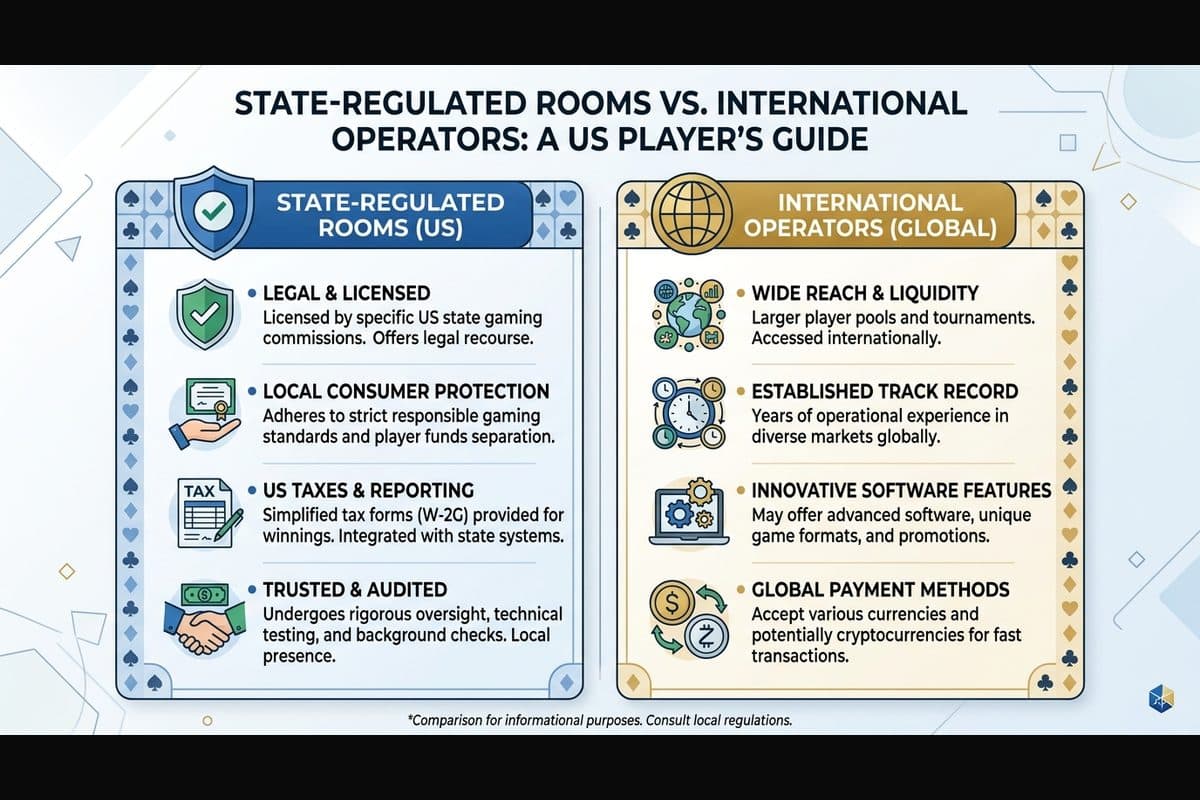
Comparison of advantages and limits between state-regulated rooms and international operators
Neither state-regulated rooms nor international operators are abstractly the "correct" choice. Each model has clear trade-offs.
State-regulated rooms
Advantages:
- •More formal consumer protection framework.
- •Traditional banking payment methods (ACH, card, physical cage).
- •Direct oversight by a state gaming commission.
Limits:
- •Only available if you physically reside in one of the active states.
- •Traffic and format variety more limited than large international networks.
International operators
Advantages:
- •Accessible from more US locations.
- •Fast crypto methods with less banking friction.
- •Greater traffic variety in cash and tournaments in some cases.
Limits:
- •Not state-regulated in the US, so formal legal protection differs.
- •Support quality and payment times depend entirely on operator reputation, without direct state oversight.
Red flags
Some signals should make you reconsider signing up, regardless of how attractive the welcome offer looks:
- •Recent and repeated complaints about withdrawals held or cancelled without clear explanation.
- •Total absence of information about licensing, years of operation, or the company behind the site.
- •Pressure to deposit large amounts before completing any identity verification.
- •Promises of "guaranteed instant withdrawals" or disproportionate rakeback without visible terms.
- •No verifiable support channels beyond a generic form.
Checklist before registering
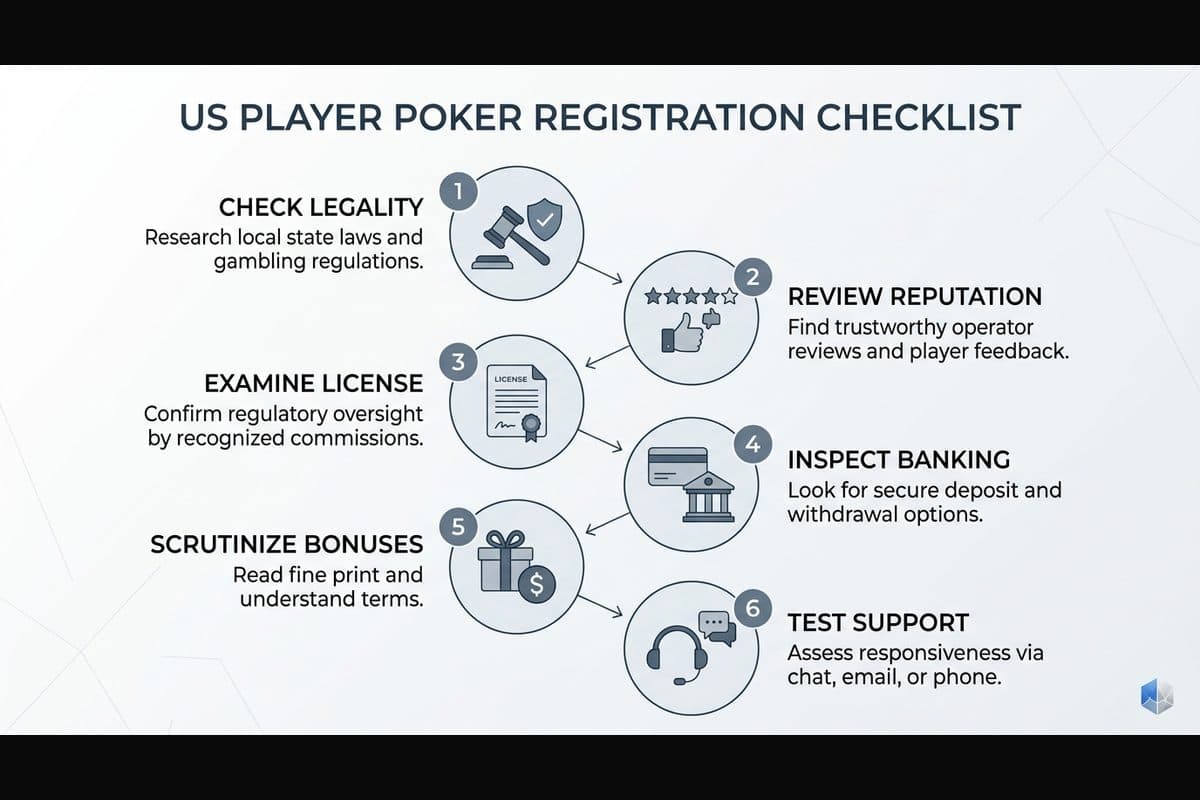
Six-step checklist before signing up at a US poker room
- 1.Confirm whether your state has active regulated rooms or whether you depend on an international operator.
- 2.Verify what deposit and withdrawal methods you can actually use from your bank or wallet.
- 3.Check what documentation will be required in the identity verification process.
- 4.Check traffic during your regular hours (EST/PST) and in your preferred format.
- 5.Search for recent reviews about payment times and support quality.
- 6.Run a small deposit and withdrawal test before moving your main bankroll.
Choose your US poker room: start comparing
Every player has a different profile: state of residence, preferred format, available hours, and payment method comfort level. Before registering, compare specific options instead of following the biggest bonus alone.
You can review rooms catering to US traffic like BetOnline, Sports Betting, or Tiger Gaming, or a crypto-focused option like CoinPoker, and cross-reference payment methods, traffic, and real terms through EasyAmericanPoker before deciding where to deposit.
This content is informational and does not constitute legal or tax advice. Online poker regulation varies by state and may change; consult official sources or a professional if you need certainty about your specific situation.