
How to Calculate Pot Odds in Poker: A Beginner's Guide to Winning Decisions

How many times have you called a bet "because it looked good" only to watch the pot go to your opponent? If you play with any regularity, the answer is probably "more times than I'd like to admit." And no, it's not bad luck. You're making decisions by gut feel at the one moment in a hand where there's actually an exact mathematical answer waiting for you.
That's where pot odds come in. They're not textbook theory or something reserved for pros—they're the simplest and most profitable tool you can add to your game today, and the strange part is that almost no casual player uses them properly. If you're looking for basic pot odds you can apply from your first session onward, this is your entry point.
This is the beginner's guide to pot odds you need: I'll walk you from zero to calculating probabilities in seconds. You'll see what pot odds are, how to calculate them step-by-step with a real example, and which mistakes are costing you money right now without you even realizing it.
We'll also look at where pot odds stop working, because no formula replaces judgment at the table. You're going to learn to calculate poker probabilities in a practical way, and most importantly you'll understand pot odds and equity poker as two sides of the same decision. Think of it as the foundation every player should master before sitting down to play seriously.
The Mistake That's Draining Your Bankroll Without You Noticing
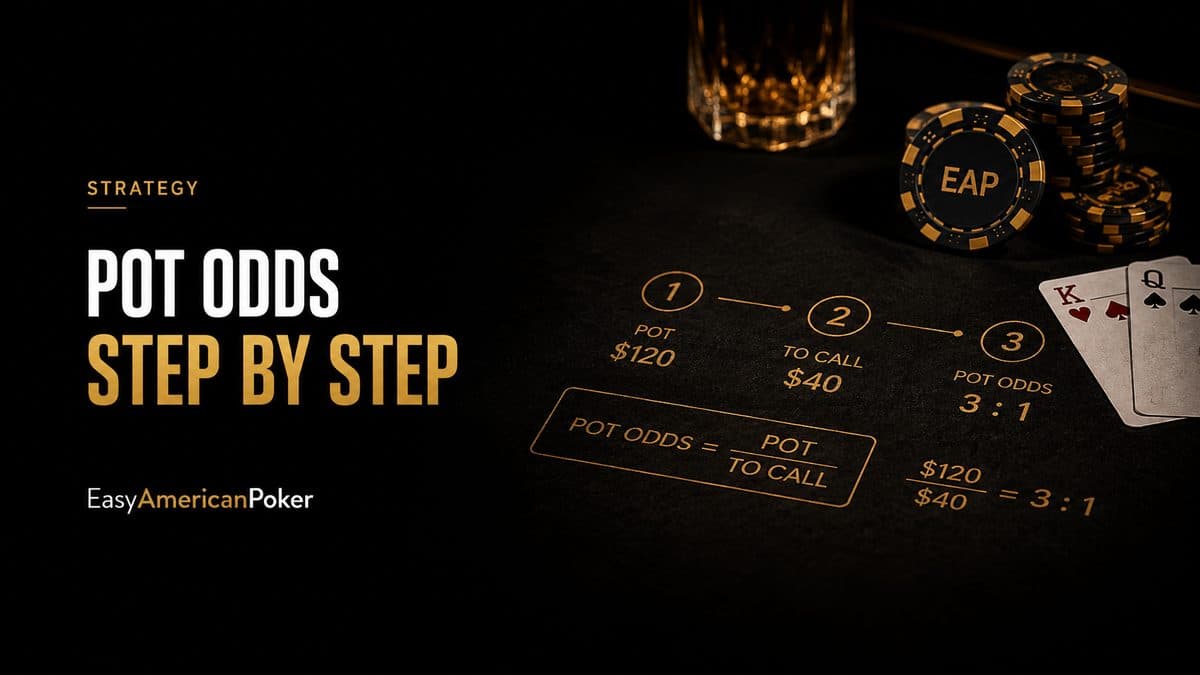
Pot odds strategy in poker step-by-step: probability calculation with example, chips and cards.
There's a scene that repeats at thousands of tables every night, whether in a brick-and-mortar cardroom or an online poker site. A player has a flush draw on the flop, his opponent bets, and he calls "because it looks good." Two streets later he doesn't hit and loses the pot.
At the next table the opposite happens: another player folds an open-ended straight draw to a small bet because "he doesn't trust it," when that call was mathematically profitable almost by default. Does either situation sound familiar? It's happened to all of us.
Neither player did anything dramatic. There was no reckless all-in or exposed bluff. It was something much quieter: they didn't calculate pot odds. And that kind of leak doesn't show up in a single session, but it definitely shows up in your month-end statement.
The uncomfortable but simple reality is this: poker doesn't forgive a lack of math—it just disguises it for a while with luck. If you don't know how to calculate pot odds, you're playing blind with your own money, and variance—which is already tough, as we covered in our guide to poker variance and its effect on bankroll—will expose you sooner or later.
In a nutshell: we're going to break down the concept of pot odds from scratch, no academic detours: what they are, what it costs you not to know them, how to calculate them step-by-step with a real example, which mistakes are draining your ROI right now, and also where their usefulness runs out, because this isn't a magic wand.
Pot Odds: What They Are and Why Ignoring Them Costs You Money
Quick summary (the essentials in 30 seconds):
| Concept | What It Means |
|---|---|
| Pot odds | % you need to win for a call to be profitable long-term |
| Formula | call ÷ (current pot + call) × 100 |
| Equity | Actual probability of completing your hand (outs × 2 or × 4) |
| Decision rule | If equity > pot odds → call. If equity < pot odds → fold |
Pot odds compare what you have to pay to the size of the pot, and tell you whether a call is profitable long-term. If your equity (probability of winning the hand) is greater than the percentage that pot odds require, pay. If it's less, fold. That's it in theory; the rest of this guide is how to calculate it correctly and not fool yourself.
If you're looking for basic pot odds explained without beating around the bush, start here: understanding pot odds and poker equity together is what separates a mathematical decision from a hunch.
Pot odds (pot probabilities) are the relationship between what you have to pay to stay in a hand and the total size of the pot once you pay. In other words: the price you're being charged to keep playing, compared to what you can win.
It's not intuition. It's not "table feel." It's a formula that tells you, in cold numbers, whether that call is profitable long-term or whether you're giving away chips.
The Real Cost of Not Calculating
There's an idea that's hard to absorb at first: nobody builds a big pot by accident. If an opponent bets hard and you call, it's because—ideally—you did the math and the numbers came out favorable. If you didn't do it, you're playing a lottery with your bankroll chips, and lotteries are won by the house long-term, not by you.
How much does it really cost you not to know this? Think about it this way: every time you have a marginal hand and pay "just because" instead of comparing your equity to the pot price, you're systematically making a worse decision than someone who does calculate.
Multiply that by hundreds of hands per session, week after week, and the compound effect is brutal. It's not one hand that tanks your ROI: it's the habit. Learning to calculate poker probabilities consistently is, at its core, what separates players who improve from those who plateau.
Watch out: pot odds don't tell you if you're going to win the hand. They tell you whether, mathematically, it's worth paying to try. Those are two different questions and lots of people confuse them.
How to Calculate Pot Odds Step-by-Step
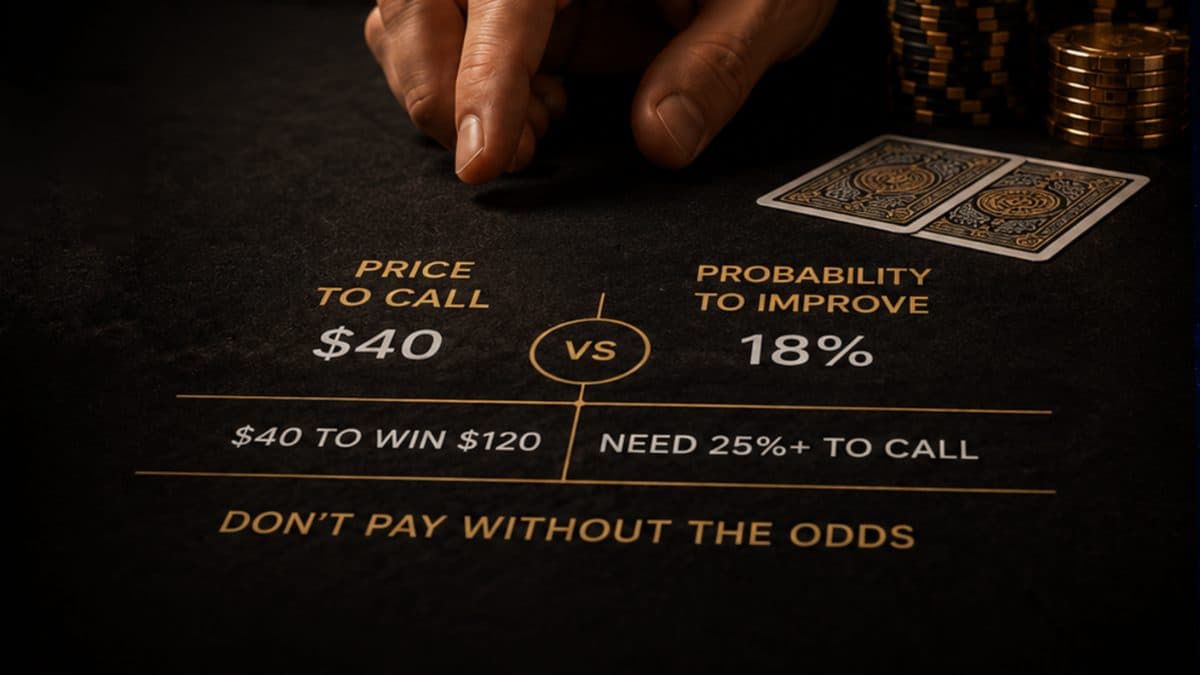
Calculating pot odds in poker: $40 to call vs 18% probability. You need 25%+ for the correct call.
Let's get down to it. To calculate your pot odds you need three pieces of information that are always on the table:
- 1.Current pot: the money already in the middle before you decide.
- 2.Amount to call: what you have to put in to stay in the hand.
- 3.Total pot if you call: current pot + opponent's bet + your call.
With these three numbers, the formula is simple:
Pot odds (%) = call ÷ (current pot + call) × 100
Simple Numerical Example
Imagine there are 100 chips in the pot and your opponent bets 50. To stay in the hand you need to pay that 50, so the total pot if you call will be 200 (100 + 50 of their bet + 50 of your call).
Your pot odds are:
50 ÷ 200 × 100 = 25%
That means you need to win the hand at least 25% of the time for that call to be profitable long-term. If you express that same thing as a ratio, it's 3 to 1: for every 3 times you lose, you only need to win 1 time to break even across all those hands.
Now comes the step that actually matters: comparing that 25% to your real equity—that is, to your probability of completing your draw based on your outs.
This is where the famous "rule of 4 and 2" comes in, a quick way to estimate equity without a calculator at the table:
- •On the flop (two cards still to come): outs × 4 ≈ % equity through the river.
- •On the turn (one card still to come): outs × 2 ≈ % equity through the river.
Tip: the rule of 4 and 2 is an approximation, not an exact value. It loses accuracy with many outs (above 8-9), so if you have a very strong draw, subtract one or two percentage points from the result to avoid overestimating your equity.
Table of Outs and Approximate Equity
So you don't have to do the math every time, here's the reference you should have half-memorized:
| Draw Type | Outs | Equity turn→river (outs×2) | Equity flop→river (outs×4) |
|---|---|---|---|
| Inside straight (gutshot) | 4 | ~9% | ~17% |
| Two overcards | 6 | ~13% | ~24% |
| Open-ended straight | 8 | ~17% | ~32% |
| Flush draw | 9 | ~19% | ~35% |
| Straight + flush combined | 15 | ~32% | ~54% |
| Pair to set | 2 | ~4% | ~8% |
Back to the example: if you had a flush draw on the flop (9 outs, ~35% equity through the river) and pot odds required only 25%, the call is mathematically correct and there's nothing to debate. If instead you only had two overcards (~24% equity), you'd already be in murky territory, almost a coin-flip against the price you're being charged.
Poker Pot Odds: Mistakes That Cost You Money
This is where the improving player separates from the one who stays stuck at the same stakes forever. These are the most common errors I see repeated over and over, at micro-limits and mid-stakes tables alike:
- •Calculating pot odds correctly but miscounting your outs. A perfect formula doesn't help if you counted outs that are actually "dirty" (for example, cards that give a flush to an opponent who was also drawing). A tainted out inflates your equity and makes you pay when you shouldn't.
- •Ignoring implied odds. Pot odds only look at the current pot. If your opponent is someone who calls you down when you hit your draw, your call might be correct even if the pure percentage says no, because you'll win more money on future streets. And the flip side: against someone who cuts losses quick, those implied odds barely exist.
- •Not adjusting for board texture. A straight draw on a three-flush board isn't worth the same as one on a dry board. Pot odds don't distinguish this on their own; you have to.
- •Confusing "I have good odds" with "I should always call." Calling with correct odds at the wrong stack depth (for example, when you don't have enough chips left to capitalize if you hit) can still be a bankroll management mistake, even if the math on that isolated call is sound.
- •Rounding wrong under time pressure. In fast online games it's easy to miscalculate in your head. Better to memorize the most common ratios (half pot ≈ 25% equity needed, full pot ≈ 33%, overbet ≈ 40%+) than try to do exact division in five seconds.
Do you see yourself in any of these mistakes? No shame—almost all of us have made them at some point. The difference is in not repeating them.
Pro tip: if you play online, many rooms display the pot and bets clearly in real-time; use that to train your mental math on real hands, not just simulators. Speed comes from repetition, not theory.
The Advantages and Limits of Using Pot Odds
Pot odds are a tool, not a life philosophy at the table. And like every tool, it does some things well and fails miserably if you use it outside its proper scope.
Real advantages:
- •Objective decisions. They replace "I've got a good feeling" with a cold number. That protects you from yourself at the moments when you need it most.
- •Reduce tilt. When you lose a call that was correct by pot odds, you know the decision was good even though the result was bad. That distinction between process and outcome is what stops a downswing from turning into a disaster session.
- •They scale with your level. The basic calculation works the same at micro-stakes as at high-roller tables; what changes is the sophistication with which you combine pot odds with implied odds, ranges, and bluff frequencies. It's a foundation that doesn't go out of date.
Clear limitations:
- •They don't work without counting outs correctly. If you miscalculate your outs, the perfect formula gives you a useless result. Garbage in, garbage out.
- •They ignore your opponent's range. Pot odds assume your equity is fixed, but it really depends on what hands you're playing against. The same draw has different equity against a wide range than against a polarized one.
- •They don't replace game sense. A player who bets predictably gives you information no mathematical formula captures. Pot odds are a complement to judgment, not a replacement for table experience.
Put another way: pot odds give you the minimum floor of a correct decision. Everything you build on top of that—reading opponents, bankroll management, table selection—still depends on you.
Frequently Asked Questions About Pot Odds
Do pot odds work the same in cash games and tournaments?
The math is identical in both formats. What changes is context: in tournaments, bubble pressure or short-stack situations can justify decisions you wouldn't make in cash, even if the pure pot odds number is the same.
Do I need to calculate pot odds in every hand?
Not every hand, but definitely in any spot where you're considering calling with a draw or marginal hand against a bet. With clearly winning or clearly losing hands, the calculation loses practical relevance.
What's the difference between pot odds and implied odds?
Pot odds look only at the current pot and the bet you face. Implied odds project the extra money you could win on future streets if you hit your draw. Both complement each other, but implied odds are more subjective because they depend on how your opponent plays.
Is it better to memorize outs tables or always calculate?
Ideally, do both. Memorizing common cases (open-ended straight, flush, two overcards) gives you speed at the table; understanding the formula lets you adjust when the situation doesn't fit a typical textbook case.
Do pot odds change based on your stack size?
The pot odds calculation itself doesn't depend on stack size, but your final decision does. If you don't have enough chips behind to capitalize when your draw hits, that lack of implied odds can turn a mathematically correct call into a bad bankroll management play.
At the end of the day, mastering pot odds won't make you an unbeatable player, but it does eliminate a silent leak that punishes most casual players without them even noticing. It's the difference between playing with a map and playing blind.
Now it's your turn: the next time you hesitate on a call, stop for five seconds and do the math before throwing chips into the middle. That habit, repeated hundreds of times per session, is what separates a player who improves from one who stays stuck.
And if you want every hand you play to work in your favor off the table too, check out how bankroll management in poker works.
Compare rooms in the EasyAmericanPoker directory to make sure you're playing where the conditions—rake, traffic, structure—also stack the odds in your favor.